How to Read a Bookmaker Review: Licensing, Terms and Evidence
Choosing a bookmaker is not something you should base on a promotional banner, a high welcome bonus or a few positive comments online. Before registering with a betting platform, it is worth understanding how the company operates, what its terms say and whether the claims made about it can be verified.
This is where bookmaker reviews can help. A good review should explain more than the available betting markets or the appearance of a website. It should give readers enough information to assess the platform, identify possible concerns and decide whether they want to investigate further.
However, not every review is equally useful. Some contain little more than promotional language, while others make strong claims without showing where the information came from.
In this guide, we explain how to read a bookmaker review, what information to look for and how to distinguish useful evidence from unsupported opinions.
What Is a Bookmaker Review?
A bookmaker review is an assessment of a sports betting platform. It usually covers areas such as the company’s background, licensing, available sports, betting markets, odds, deposits, withdrawals, customer support and terms and conditions.
The purpose is to help readers understand what a platform offers and what they should check before deciding whether to use it.
A useful review should not simply describe every feature as excellent. It should explain both the advantages and limitations of the service, identify information that could not be independently confirmed and provide evidence for important claims.
For a broader introduction to evaluating betting platforms, see our guide to choosing a sports betting site in Nigeria.
Why Should You Read a Bookmaker Review Carefully?
Two betting platforms may look similar when you first visit them, but their operating arrangements, withdrawal conditions, market coverage and customer service can be very different.
A review can help you identify questions that might not be obvious from the homepage. For example:
- Who operates the betting platform?
- Is there a verifiable licence or regulatory authorisation?
- What conditions apply to deposits and withdrawals?
- Are bonus offers subject to restrictions?
- How are betting disputes handled?
- Can the review support its claims with reliable evidence?
These questions matter because a platform’s advertising does not necessarily explain every condition attached to its services.
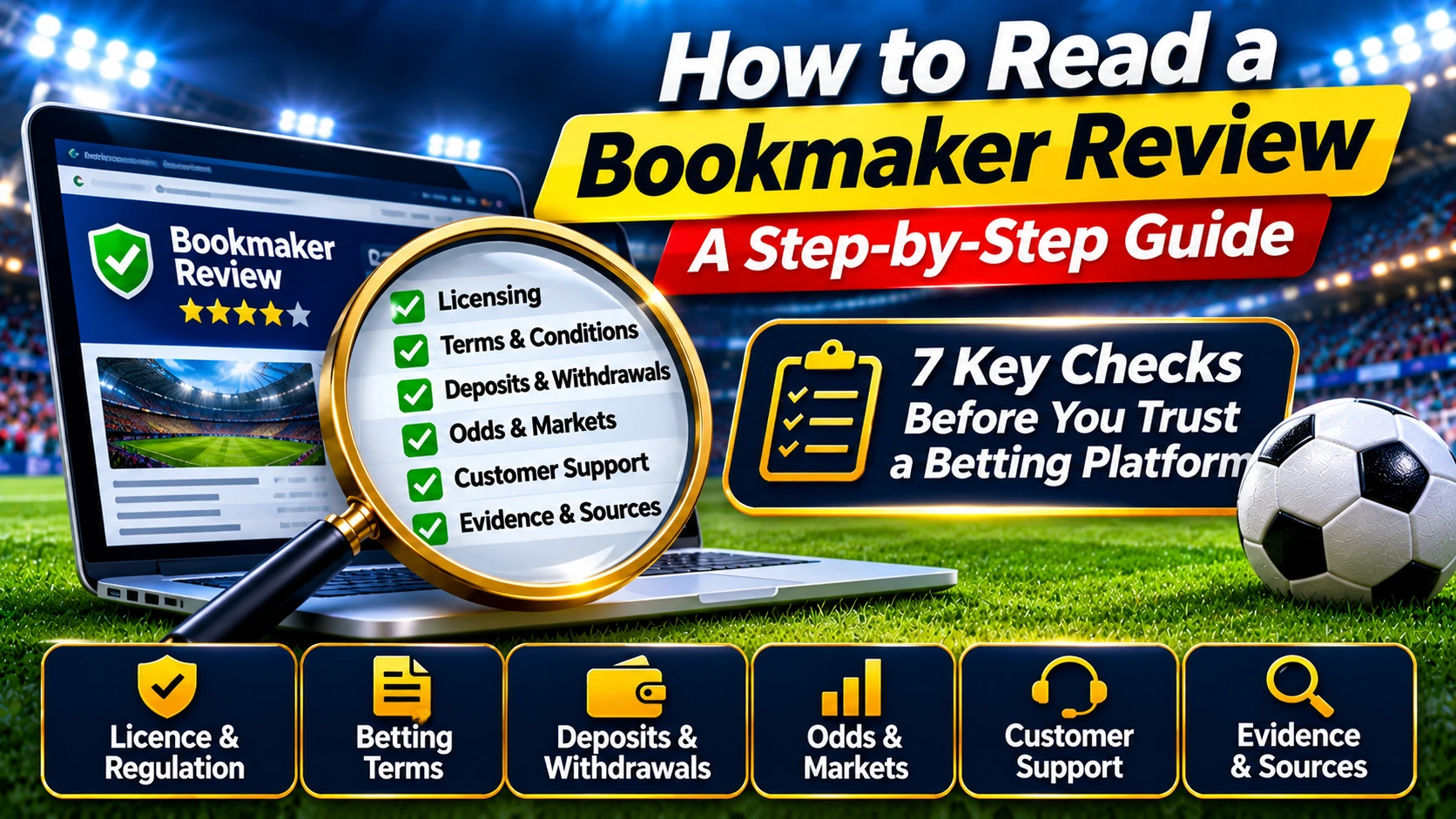
7 Important Things to Check When Reading a Bookmaker Review
1. Check the bookmaker’s identity and ownership
Start by finding out which company operates the betting platform. A website’s brand name may be different from the legal name of the company responsible for the service.
A detailed review should identify the operating company where this information is available. It should also explain how the information was obtained, rather than presenting an unverified company name as fact.
You can look for company information in the platform’s terms and conditions, privacy policy and other relevant legal documents. If the company details are unclear or inconsistent across the website, that is a reason to investigate further.
2. Verify licensing and regulatory information
Licensing is one of the most important subjects in a bookmaker review. A credible assessment should identify the relevant regulator, the licensed entity, the applicable jurisdiction and the status of the authorisation where this information can be verified.
Do not rely only on a logo or a sentence saying that a bookmaker is licensed. Look for the regulator’s official register or other authoritative records.
When checking a licence, consider these questions:
- Does the regulator have a publicly accessible register?
- Does the listed company match the operator named by the bookmaker?
- Does the authorisation cover the relevant betting activity?
- Is the licence current, suspended or expired?
- Does the licence apply to the jurisdiction in which the service is being offered?
Licensing arrangements differ between jurisdictions. An authorisation in one location should not automatically be interpreted as permission to operate everywhere.
A good review should explain what was checked and when it was checked. Regulatory information can change, so the date of verification matters.
3. Read the terms and conditions
The terms and conditions explain the rules that apply when customers use a betting platform. Although they are not always the most interesting part of a website, they can contain some of the most important information.
Pay particular attention to:
- Account requirements: Eligibility, age restrictions, identity verification and account rules.
- Deposits: Accepted payment methods, minimum amounts and any applicable restrictions.
- Withdrawals: Verification requirements, processing conditions, limits and possible fees.
- Bonuses: Wagering requirements, expiry dates, eligible markets and withdrawal restrictions.
- Bet settlement: Rules for postponed, abandoned, cancelled or rescheduled events.
- Account restrictions: Circumstances in which accounts or transactions may be limited.
Do not assume that a bonus is free money simply because it is advertised as a welcome offer. Read the full conditions and understand what is required before accepting it.
4. Examine deposits and withdrawals
Payment information is another important part of a bookmaker review. A platform may advertise several payment options, but you should still understand the conditions attached to using them.
Look for information about supported payment methods, minimum and maximum transaction amounts, identity checks, processing procedures and any fees that may apply.
It is also important to distinguish between a bookmaker’s published processing policy and a customer’s personal experience. A review should not claim that every withdrawal is instant simply because one person received a payment quickly.
Where a review discusses withdrawal speed, it should explain whether the information comes from published terms, direct testing or independently verifiable customer reports.
5. Compare odds and betting markets
The range of sports and betting markets can affect how useful a bookmaker is to different customers. Some people mainly follow football, while others are interested in basketball, tennis or other competitions.
A review should explain which sports and markets are available and whether the information is based on an actual inspection of the platform.
Odds also deserve attention. Two bookmakers can offer different prices for the same event and selection. Comparing equivalent markets at approximately the same time gives a more meaningful picture than looking at unrelated examples.
If you are unfamiliar with the different types of selections, our guides to football betting markets and football betting odds explain the basics.
6. Look at customer support and dispute procedures
Customer support matters when users have questions about their accounts, payments, verification or unsettled bets.
A bookmaker review should identify the support channels the platform actually provides. These might include live chat, email or telephone support, depending on the service.
It is also useful to check whether the terms explain how complaints are submitted and escalated. A platform’s published complaint procedure is more informative than a vague statement that customer service is excellent.
If a review claims that support is available around the clock, look for evidence of the stated availability and the date it was checked.
7. Examine the review’s sources and evidence
This is one of the easiest ways to judge whether a bookmaker review deserves your attention.
When an article makes a factual claim, ask where that information came from. Does it link to a regulator’s register, the bookmaker’s terms, an official company document or a clearly explained test?
Useful evidence may include:
- Official regulatory records.
- Company information and legal documents.
- Published payment and account terms.
- Direct observations of the website and its features.
- Clearly identified customer experiences, presented with appropriate context.
Be cautious when a review uses phrases such as “100% safe”, “guaranteed withdrawals” or “the best bookmaker” without explaining how those conclusions were reached.
A trustworthy review should separate confirmed facts from personal opinions and information that remains uncertain.
How to Recognise a Poor-Quality Bookmaker Review
Not every article labelled as a bookmaker review provides meaningful research. Some are written mainly to promote a particular platform or encourage readers to register.
Watch out for these warning signs:
- No identifiable operator: The review never explains which company runs the platform.
- Unverified licence claims: It says the bookmaker is licensed but provides no regulator or supporting information.
- Unrealistic promises: It guarantees winning bets, instant payments or risk-free gambling.
- Missing terms: It discusses bonuses and promotions without explaining their conditions.
- Only positive comments: It avoids discussing limitations or possible concerns.
- Outdated information: It does not show when important details were last checked.
- No supporting sources: Important factual claims appear without links or explanations.
A review does not need to be negative to be independent. It simply needs to be fair, transparent and supported by evidence.
How to Compare Two Bookmaker Reviews
If you are comparing two betting platforms, avoid choosing one simply because its review is longer or contains more promotional language.
Instead, compare the same areas for both platforms:
| What to compare | What to look for |
|---|---|
| Operator identity | Clearly identified operating company |
| Licensing | Verifiable regulatory information |
| Terms | Clear account, bonus and settlement rules |
| Payments | Published deposit and withdrawal conditions |
| Betting markets | Sports, competitions and available selections |
| Customer support | Available contact channels and complaint procedures |
| Evidence | Sources, verification dates and transparent testing |
This approach makes it easier to identify meaningful differences and avoid being influenced by marketing language alone.
Example: What a Useful Bookmaker Review Should Tell You
Imagine you are reading a review of a betting platform. The article says the bookmaker is licensed, offers fast withdrawals and provides excellent customer support.
Those statements may sound reassuring, but they are not enough on their own. You should expect the review to answer several follow-up questions.
- Which legal company operates the platform?
- Which regulator issued the authorisation?
- Where can the licence information be independently checked?
- What do the published withdrawal terms actually say?
- Which support channels were confirmed to be available?
- When was the information last reviewed?
If the article answers these questions and provides appropriate sources, it gives you a stronger basis for evaluating the platform. If it simply repeats promotional claims, you should look for additional information.
Read Our 8xbet Review
If you are researching 8xbet, you can also read our dedicated 8xbet review for Nigeria.
Use the same approach discussed in this guide: examine the operator information, check relevant regulatory records, read the terms and conditions, and assess the available evidence. Do not rely on a single article as a substitute for your own checks.
For more information about evaluating betting platforms in the Nigerian market, see our guide to choosing sports betting sites in Nigeria.
Frequently Asked Questions About Bookmaker Reviews
What should I look for in a bookmaker review?
Look for the operator’s identity, licensing information, terms and conditions, payment procedures, betting markets, customer support and evidence supporting the review’s claims.
How can I tell if a bookmaker review is trustworthy?
A useful review identifies its sources, explains how important information was checked, separates facts from opinions and discusses both benefits and limitations without making unrealistic promises.
Why is licensing important when choosing a bookmaker?
Licensing helps establish whether an operator has authorisation from a relevant regulator for specified activities in a particular jurisdiction. The licence should be checked against the regulator’s records rather than accepted based on a website badge alone.
Should I trust bookmaker reviews that promise guaranteed winnings?
No. Football results are uncertain, and no bookmaker review or betting strategy can guarantee a winning outcome. Treat guaranteed-profit claims as a serious warning sign.
Do bookmaker reviews include withdrawal information?
Good reviews should discuss published withdrawal conditions, verification requirements, supported methods and any stated processing procedures. They should distinguish these policies from individual customer experiences.
Are all bookmaker reviews independent?
No. Some websites may earn commissions when readers visit or register with a bookmaker through their links. A responsible review should disclose relevant commercial relationships and still present accurate, balanced information.
Final Thoughts
Knowing how to read a bookmaker review can help you look beyond promotional claims and focus on the information that matters. Start with the operator’s identity and licensing, examine the terms, understand the payment conditions and look for evidence behind important statements.
Most importantly, do not assume that a positive review means a betting platform is automatically suitable for you. Verify important details independently and take time to understand the risks before making any decision.
Sports betting involves financial risk and should never be treated as a reliable way to earn income. Set personal limits, avoid borrowing to gamble and seek support if gambling becomes difficult to control. Read our responsible gambling guide for more information.