Over/Under Goals Betting Explained: Goal Lines and Examples
When watching a football match, the final score is not the only thing that matters to someone studying betting markets. The total number of goals scored by both teams can also form the basis of a selection. This is where Over/Under goals betting comes in.
Over/Under is a market in which you predict whether the combined goals in a match will be above or below a particular number set by the bookmaker. You do not have to predict which team will win. Instead, your selection depends on the total goals scored by both sides.
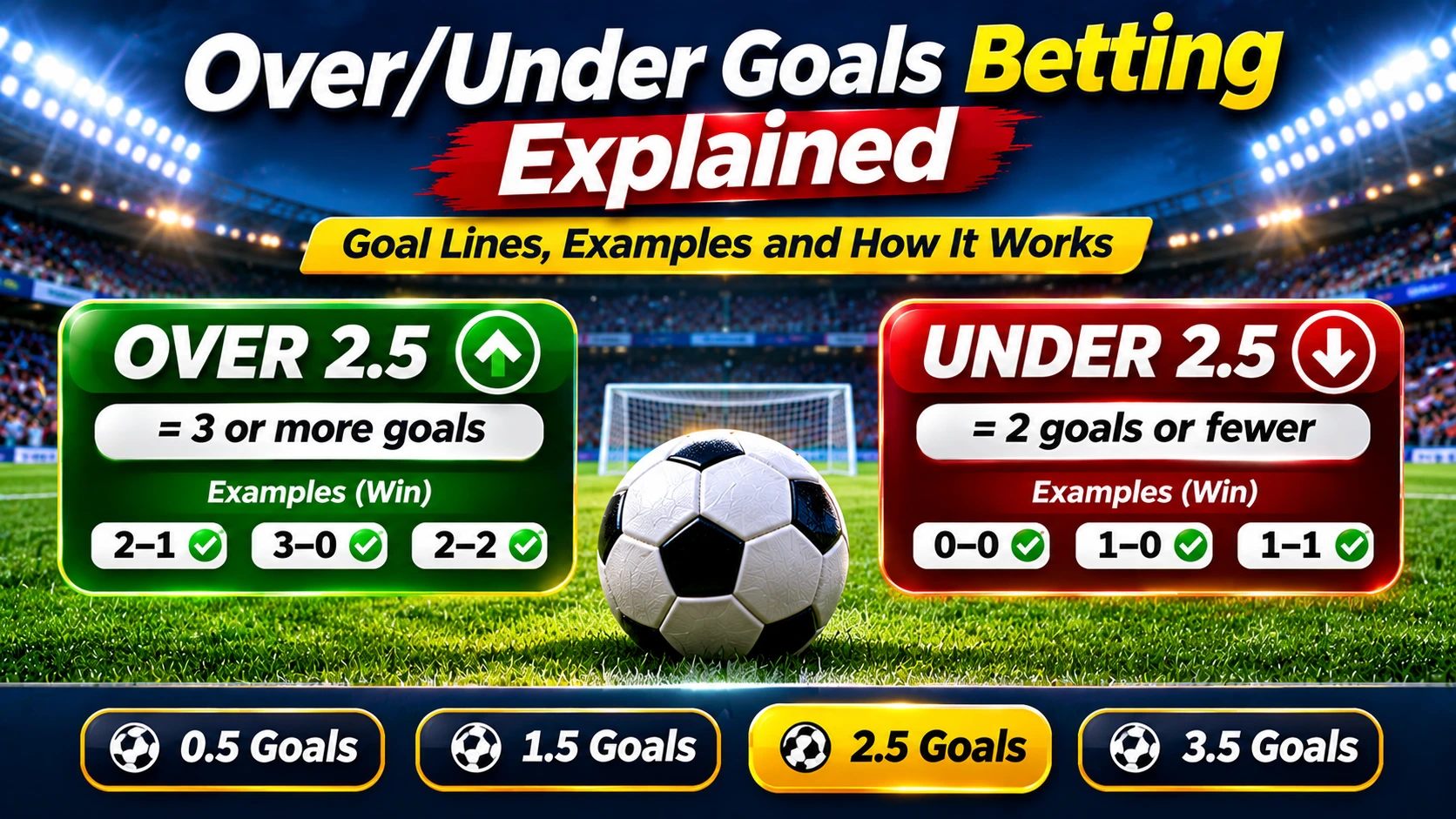
For example, if you select Over 2.5 Goals, the match needs to produce at least three goals for the selection to win. If you select Under 2.5 Goals, the match must finish with two goals or fewer.
Let’s break down how the market works, what common goal lines mean, and how different scorelines affect your selection.
What Does Over/Under Goals Mean in Football Betting?
Over/Under goals betting is a football market based on the total number of goals scored by both teams during a specified period. The bookmaker provides a goal line, and you choose whether the final total will be above or below it.
There are two basic options:
- Over: You predict that the combined number of goals will be higher than the selected goal line.
- Under: You predict that the combined number of goals will be lower than the selected goal line.
For instance, consider a match between Team A and Team B. If the final score is 2–1, the total is three goals. If the score is 1–0, the total is only one goal.
The calculation is simple: add the goals scored by both teams. The result is the total used to settle the market, subject to the bookmaker’s rules.
How Does Over 2.5 Goals Work?
Over 2.5 Goals is one of the most familiar goal-total markets. The half-goal line means there cannot be an exact tie with the selected number of goals.
To win an Over 2.5 selection, the match must produce at least three goals in total.
Here are some examples:
- 2–1: Three goals — Over 2.5 wins.
- 3–0: Three goals — Over 2.5 wins.
- 2–2: Four goals — Over 2.5 wins.
- 1–1: Two goals — Over 2.5 loses.
- 1–0: One goal — Over 2.5 loses.
- 0–0: No goals — Over 2.5 loses.
It does not matter which team scores the goals. The only requirement is that the combined total reaches three or more.
How Does Under 2.5 Goals Work?
Under 2.5 Goals is the opposite selection. You are predicting that the match will finish with no more than two goals in total.
Examples of results that fall below the 2.5 goal line include:
- 0–0: Zero goals — Under 2.5 wins.
- 1–0: One goal — Under 2.5 wins.
- 1–1: Two goals — Under 2.5 wins.
- 2–0: Two goals — Under 2.5 wins.
Results such as 2–1, 3–0 and 2–2 produce at least three goals, so Under 2.5 loses.
Notice that Under 2.5 does not necessarily mean you expect a goalless match. A 2–0 or 1–1 result still satisfies the selection.
Understanding Common Over/Under Goal Lines
Bookmakers offer different goal lines because matches can have different scoring expectations. Understanding the number attached to a selection is essential before placing a bet.
Over/Under 0.5 Goals
Over 0.5 means you expect at least one goal in the match. A 1–0, 0–1 or 1–1 result would satisfy this selection. A 0–0 draw would not.
Under 0.5 means you expect the match to finish without any goals. Only a 0–0 result satisfies this selection under standard settlement rules.
Over/Under 1.5 Goals
Over 1.5 requires at least two goals in total. A 1–1, 2–0 or 2–1 result would win.
Under 1.5 requires zero or one goal. Results such as 0–0, 1–0 and 0–1 would satisfy the selection.
Over/Under 2.5 Goals
Over 2.5 requires at least three goals, while Under 2.5 requires two goals or fewer. This is a commonly offered line in football betting.
Over/Under 3.5 Goals
Over 3.5 requires at least four goals. A 2–2, 3–1 or 4–0 result would win.
Under 3.5 requires three goals or fewer. Results such as 0–0, 1–1, 2–1 and 3–0 would satisfy the selection.
Over/Under Goal Lines: Scoreline Examples
The following table shows how some common scorelines affect different goal lines.
| Final score | Total goals | Over 1.5 | Over 2.5 | Over 3.5 |
|---|---|---|---|---|
| 0–0 | 0 | Loses | Loses | Loses |
| 1–0 | 1 | Loses | Loses | Loses |
| 1–1 | 2 | Wins | Loses | Loses |
| 2–1 | 3 | Wins | Wins | Loses |
| 2–2 | 4 | Wins | Wins | Wins |
| 3–2 | 5 | Wins | Wins | Wins |
For the corresponding Under selections, the result is the opposite for these half-goal lines: a total below the line wins, while a total above it loses.
What Are Asian Over/Under Goal Lines?
Some bookmakers also offer Asian goal totals, which can include whole-number and quarter-goal lines. These markets work differently from the familiar half-goal selections because a stake can sometimes be divided between two related lines.
Whole-number goal lines
Consider Over 2.0 Goals. If the match finishes with three or more goals, the selection wins. If it finishes with exactly two goals, the stake is normally returned as a push. If it finishes with fewer than two goals, the selection loses.
Under 2.0 works in the opposite direction: fewer than two goals wins, exactly two goals normally results in a returned stake, and more than two goals loses.
Quarter-goal lines
A selection such as Over 2.25 combines two goal lines: Over 2.0 and Over 2.5. The stake is divided equally between them.
For example, with a ₦1,000 stake on Over 2.25:
- ₦500 is placed on Over 2.0.
- ₦500 is placed on Over 2.5.
If the match finishes with exactly two goals, the Over 2.0 portion is normally returned, while the Over 2.5 portion loses. This is a half-loss overall.
If the match produces three or more goals, both portions win. If it produces fewer than two goals, both portions lose.
Asian goal totals have more complicated settlement rules than standard half-goal markets. Always check the bookmaker’s market description before selecting one.
How Are Over/Under Odds Calculated?
Odds represent the price offered for a selection. Decimal odds make it easy to calculate the potential return from a winning bet.
Suppose you stake ₦2,000 on Over 2.5 Goals at decimal odds of 1.75.
- Stake: ₦2,000.
- Odds: 1.75.
- Potential total return: ₦2,000 × 1.75 = ₦3,500.
- Potential profit: ₦3,500 − ₦2,000 = ₦1,500.
This is an illustration assuming the selection wins, with no applicable deductions. A losing selection normally means the stake is lost.
To understand decimal odds more thoroughly, read our guide to how football betting odds work.
Over/Under Goals vs BTTS: What Is the Difference?
Over/Under and Both Teams to Score (BTTS) are both goal-related markets, but they measure different things.
Over/Under looks at the combined number of goals. BTTS looks at whether each team scores at least once.
Consider these examples:
- 3–0: Over 2.5 wins, but BTTS Yes loses because only one team scores.
- 1–1: BTTS Yes wins, but Over 2.5 loses because there are only two goals.
- 2–1: Both Over 2.5 and BTTS Yes win.
- 1–0: Both Over 2.5 and BTTS Yes lose.
These markets can sometimes produce different outcomes from the same scoreline. Read our separate guide to BTTS betting explained to understand how the Yes and No selections work.
Factors to Consider When Assessing Over/Under Goals
There is no reliable way to know exactly how many goals a football match will produce before kick-off. However, several factors can help you assess a fixture more carefully.
1. Recent scoring and conceding records
Look at the number of goals each team has scored and conceded across a reasonable sample of recent matches. A team that regularly creates chances but also allows opponents to score may produce a different goal profile from a defensively organised side.
2. Home and away form
Some teams perform differently depending on where they play. Review home scoring records for the home side and away scoring records for the visitors. Separate records can provide useful context that overall statistics may hide.
3. Playing style and tactics
Teams that press aggressively, attack with several players or leave space behind their defence may create matches with more scoring opportunities. Other teams prefer to defend deep and limit chances.
However, tactical labels alone are not enough. Look at how the teams actually perform against comparable opponents.
4. Injuries and team selection
Missing forwards, creative midfielders or important defenders can influence the expected flow of a match. Check recent team news and confirmed line-ups when available rather than relying on outdated injury reports.
5. Match importance and fixture schedule
Competition format, the need for points and fixture congestion can influence team selection and tactical decisions. A side playing its third match in a short period may approach a fixture differently from one that has had a full week to prepare.
6. Head-to-head records in context
Previous meetings can provide background, but they should not be treated as a prediction. Managers, players and tactical systems change. Give more attention to current team performance than to an old head-to-head result.
Common Over/Under Betting Mistakes
Confusing the goal line
Over 1.5 and Over 2.5 are not the same selection. Always check the exact number before confirming a bet. One additional goal can make the difference between a winning and losing selection.
Assuming a big team will always score several goals
Reputation does not guarantee a high-scoring performance. Even strong attacking sides can struggle against organised opponents.
Ignoring the opposing team’s contribution
Over/Under is based on the combined total, so you should assess both teams. Looking only at the home side’s scoring record can leave out important information about the visitors.
Using statistics without context
Averages can be misleading if they come from matches against very different opponents or from an unusual run of results. Consider the quality of opposition, home and away conditions and recent team changes.
Thinking a previous low-scoring match means the next one must have more goals
Football matches are independent events in this respect. A goalless match does not make a high-scoring result more likely in the next fixture simply because goals were missing previously.
Frequently Asked Questions About Over/Under Goals
What does Over 2.5 Goals mean?
Over 2.5 means the match must produce at least three combined goals. Results such as 2–1, 3–0 and 2–2 satisfy this selection.
What does Under 2.5 Goals mean?
Under 2.5 means the match must finish with two goals or fewer. Results such as 0–0, 1–0, 1–1 and 2–0 satisfy this selection.
Does Over 1.5 mean at least two goals?
Yes. Over 1.5 requires two or more combined goals. A 1–1 or 2–0 result would satisfy it, while a 1–0 result would not.
What happens if a match finishes 2–1 on Over 2.5?
A 2–1 result contains three goals in total, so Over 2.5 normally wins.
What is the difference between Over 2.0 and Over 2.5?
Over 2.0 is a whole-number Asian goal line. Exactly two goals normally results in a returned stake, while Over 2.5 loses with exactly two goals. Check the bookmaker’s settlement rules.
Does Over/Under include extra time?
Standard football goal-total markets usually cover regular playing time, including stoppage time, but not extra time or penalties. Always check the specific market’s rules because the period covered can differ.
Is Over 2.5 better than Over 1.5?
Neither is automatically better. They have different winning conditions and usually different odds. The appropriate line depends on the match, the price offered and your assessment of the likely total goals.
Final Thoughts
Over/Under goals betting becomes easier to understand once you know how the goal lines work. Over 1.5 requires at least two goals, Over 2.5 requires at least three, and Over 3.5 requires at least four. The Under selections work in the opposite direction.
Before assessing a match, consider both teams’ scoring and defensive records, home and away performances, team news and the tactical situation. Do not rely on a single statistic or assume that previous results guarantee a particular outcome.
Betting involves financial risk. Set a limit you can afford, never borrow money to gamble and do not chase losses. If betting stops being enjoyable or becomes difficult to control, take a break and seek support. Read our responsible gambling guide for more information.