BTTS Betting Explained: What Yes and No Mean
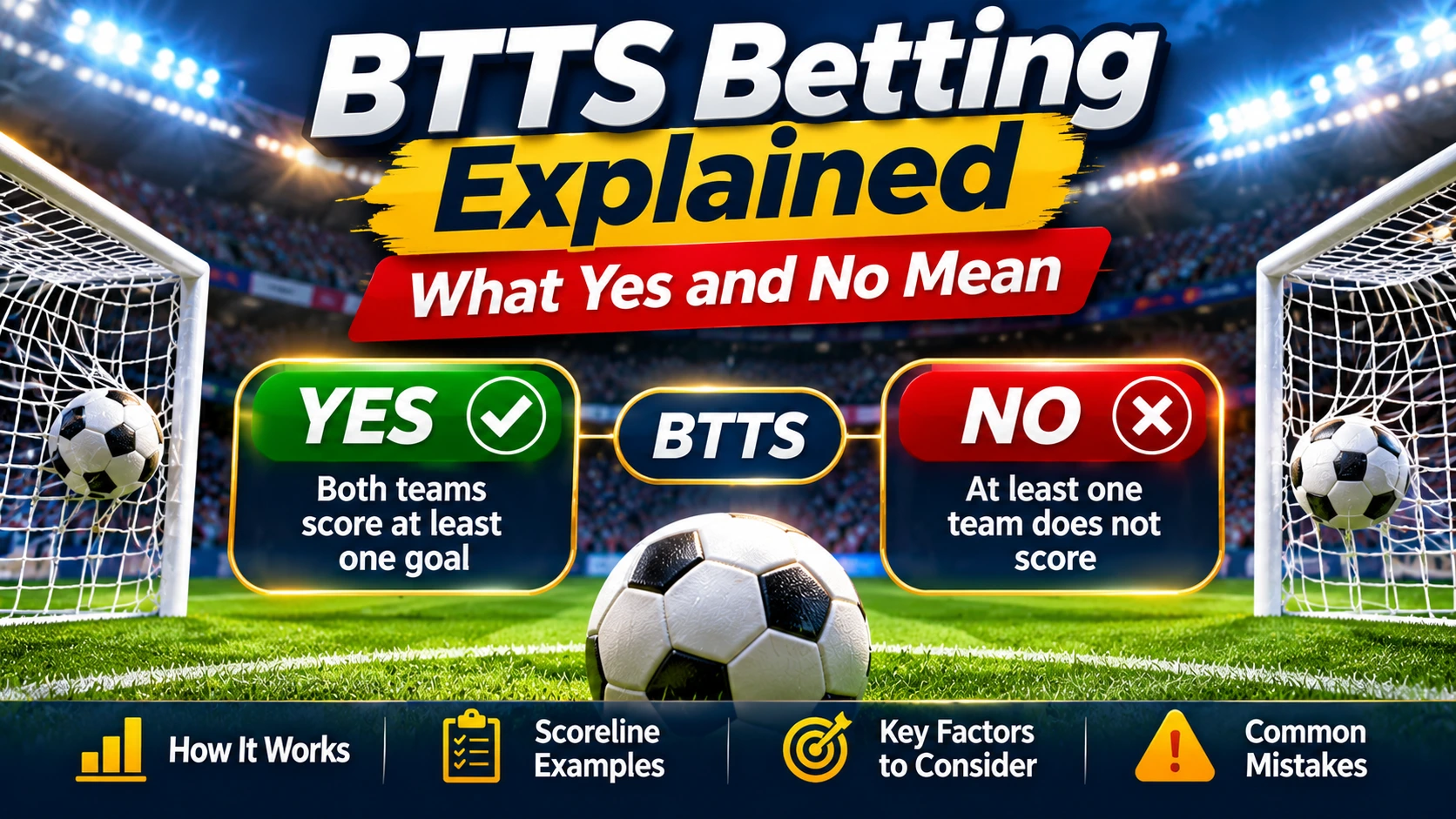
BTTS is one of the most common markets in football betting, but its name can be confusing if you are new to the game. BTTS stands for Both Teams to Score. Instead of predicting which team will win, you are predicting whether both sides will score at least one goal during the match.
For example, if you select BTTS Yes in a match between Arsenal and Chelsea, you need Arsenal and Chelsea to score at least once each for the selection to win. The final score could be 1–1, 2–1, 1–2 or even 3–3. The important point is that both teams must score.
This guide explains how BTTS betting works, the difference between Yes and No, how different scorelines affect your selection, and what to consider when assessing a football match.
What Does BTTS Mean in Football Betting?
BTTS means Both Teams to Score. It is a football betting market based on whether each team scores at least one goal within the period covered by the market, usually the regular 90 minutes plus stoppage time.
There are normally two basic options:
- BTTS Yes: Both teams must score at least one goal.
- BTTS No: At least one team must fail to score.
Unlike a traditional match-result bet, BTTS does not require you to predict the winner. A team can win, lose or draw while your BTTS selection still wins, provided the scoreline meets the market’s conditions.
If you are still learning the different types of football bets, read our guide to football betting markets explained for a broader overview.
How Does BTTS Yes Betting Work?
When you choose BTTS Yes, you are predicting that both teams will find the net at least once. The teams do not need to score the same number of goals, and neither team has to win.
Consider a match between Team A and Team B. If your selection is BTTS Yes, these are examples of possible outcomes:
- 1–1: Wins because both teams score.
- 2–1: Wins because both teams score.
- 1–3: Wins because both teams score.
- 0–0: Loses because neither team scores.
- 2–0: Loses because Team B does not score.
- 0–2: Loses because Team A does not score.
The final score matters more than which team controls possession or has more shots. A side can dominate a match and still fail to score, which would make BTTS Yes unsuccessful if its opponent scores alone.
How Does BTTS No Betting Work?
BTTS No is the opposite selection. You are predicting that at least one team will finish without scoring a goal during the period covered by the market.
Examples of scorelines that normally settle as BTTS No include:
- 0–0: Neither team scores.
- 1–0: Only one team scores.
- 0–2: Only one team scores.
- 3–0: One team scores, but the other does not.
However, scorelines such as 1–1, 2–1 and 2–2 would normally make BTTS No unsuccessful because both teams scored.
Remember that BTTS No does not necessarily mean you expect a boring match. One team could score several goals while keeping a clean sheet. Your selection only requires at least one side to fail to score.
BTTS Scoreline Examples at a Glance
| Final score | BTTS Yes | BTTS No |
|---|---|---|
| 0–0 | Loses | Wins |
| 1–0 | Loses | Wins |
| 0–2 | Loses | Wins |
| 1–1 | Wins | Loses |
| 2–1 | Wins | Loses |
| 2–2 | Wins | Loses |
These examples assume a standard BTTS market settled on the match’s regular playing time, including stoppage time. Always check the specific bookmaker’s settlement rules, especially for markets covering extra time or other periods.
How to Assess a Match for BTTS
No statistic can guarantee that both teams will score. However, looking at several relevant factors can help you make a more informed assessment instead of relying on team names or recent results alone.
1. Check each team’s scoring record
Look at how consistently both teams have scored in their recent matches. A team that regularly fails to score may be a concern for BTTS Yes, even if its opponent has a strong attack.
Consider a reasonable sample of matches rather than drawing conclusions from just one or two games. Also check whether the teams faced opponents of a similar standard.
2. Compare home and away performances
Some teams score regularly at home but struggle to create chances away from home. Others concede more frequently when playing away. Reviewing home and away records separately can reveal patterns that an overall record may hide.
For example, a home side may have scored in eight of its last ten home matches, while the visiting team has scored in seven of its last ten away matches. That information may be useful, but it does not guarantee that either team will score in the next fixture.
3. Examine defensive weaknesses
Check how often each team concedes, not just how many goals it scores. A team with a productive attack but a vulnerable defence may create a different BTTS profile from a side that scores and defends well.
Recent clean sheets, goals conceded and the quality of opponents can help provide context. Avoid treating a single statistic as a complete prediction.
4. Consider injuries, suspensions and team news
The absence of a key striker, creative midfielder or first-choice goalkeeper can affect a team’s scoring chances or defensive stability. Before making an assessment, look for reliable and recent team news.
Do not assume a player is unavailable based on an old report. Line-ups and injury updates can change close to kick-off.
5. Review the match context
Competition format, tactical approach, fixture congestion and the importance of the result may influence how teams play. A match in which both teams need a win may develop differently from a fixture where one side is content to defend a lead.
These factors provide context rather than certainty. Even a match that appears suitable for BTTS can finish 1–0 or 0–0.
BTTS Odds Explained
BTTS odds show the price offered for the Yes or No selection. Decimal odds are commonly used by bookmakers in Nigeria and elsewhere.
For example, suppose BTTS Yes is offered at decimal odds of 1.80 and you stake ₦1,000:
- Potential total return: ₦1,000 × 1.80 = ₦1,800.
- Potential profit: ₦1,800 − ₦1,000 = ₦800.
This calculation assumes the selection wins and excludes any applicable deductions or special terms. If the selection loses, the stake is normally lost.
Decimal odds can also be converted into an implied probability by dividing 1 by the odds and multiplying by 100. At odds of 1.80, the raw implied probability is approximately 55.6%. This is not a guarantee or an objective measure of the true chance; bookmaker margins affect the prices offered.
For more examples, see our guide to how football betting odds work.
BTTS vs Over/Under Goals
BTTS and Over/Under Goals are different markets, even though both relate to goals scored during a match.
BTTS focuses on whether each team scores. Over/Under focuses on the total number of goals scored by both teams combined, according to the selected goal line.
For example, a 1–0 result means only one team scored, so BTTS No wins. The same score produces one total goal, which is below the common Over/Under 2.5 line.
A 2–1 result makes BTTS Yes a winning selection and produces three total goals, which is over 2.5. However, a match can go over 2.5 goals without BTTS Yes winning: a 3–0 result is an example.
Do not treat these markets as interchangeable. Read the conditions of each selection before placing a bet.
Common BTTS Betting Mistakes
Assuming both teams will score because they have strong attacks
Good attacking players do not guarantee goals. Finishing, tactical match-ups, goalkeeping and the quality of chances all influence the result.
Looking only at the last match
One high-scoring or goalless result is not enough to establish a reliable pattern. Review a broader sample and consider the opponents and match conditions.
Confusing BTTS with Over 2.5 Goals
BTTS Yes can win in a 1–1 draw, even though that is only two goals. Over 2.5 can win in a 3–0 match, even though BTTS Yes loses. Each market has its own settlement condition.
Choosing a selection just because the odds look attractive
Higher odds do not automatically mean better value. Consider what the price implies, what evidence supports your assessment and how uncertain the outcome remains.
Adding too many selections to an accumulator
Combining several bets can make a potential return look appealing, but every additional selection introduces another way for the overall bet to lose. Review our Double Chance Betting Explained guide to learn about a different market, and remember that no betting method removes risk.
Frequently Asked Questions About BTTS
What does BTTS mean in football?
BTTS means Both Teams to Score. A Yes selection normally wins when each team scores at least one goal during the period covered by the market.
What does BTTS Yes mean?
BTTS Yes means you expect both teams to score. Scorelines such as 1–1, 2–1 and 1–2 would normally satisfy this selection.
What does BTTS No mean?
BTTS No means you expect at least one team not to score. Scorelines such as 0–0, 1–0 and 0–2 would normally satisfy this selection.
Can BTTS win in a 1–1 draw?
Yes. Both teams have scored, so BTTS Yes normally wins regardless of the fact that the match is a draw.
Does BTTS mean Over 2.5 Goals?
No. BTTS concerns whether both teams score, while Over/Under concerns the combined number of goals. A 1–1 score wins BTTS Yes but does not go over 2.5 goals.
Is BTTS a guaranteed way to make money?
No. Football results are uncertain, and no betting market or prediction method guarantees profit. Only stake money you can afford to lose, and do not chase losses.
Final Thoughts
BTTS betting is straightforward once you understand the difference between Yes and No. Yes requires both teams to score at least once; No requires at least one team to finish without a goal under the market’s settlement rules.
When assessing a match, consider each team’s scoring record, defensive performance, home and away form, team news and match context. Use evidence rather than assumptions, and remember that past results cannot guarantee what happens next.
Betting involves financial risk. Set a budget, never borrow to bet and stop if gambling becomes difficult to control. You can read our responsible gambling guide for more information about keeping betting within limits.