Draw No Bet Explained: Meaning, Examples and How It Works
Draw No Bet (DNB) is a football betting market that allows you to select either the home team or the away team to win, with your stake normally returned if the match finishes in a draw.
It is an alternative to the traditional 1X2 market, where you must choose a home win, draw or away win. With Draw No Bet, the draw is excluded as a losing outcome for your selected team.
But what exactly does Draw No Bet mean? How does it work, how are winning selections settled, and what happens to your money when a match ends in a draw?
This guide explains the DNB betting market with practical football examples, decimal odds calculations and a comparison with Double Chance betting.
What Does Draw No Bet Mean in Football Betting?
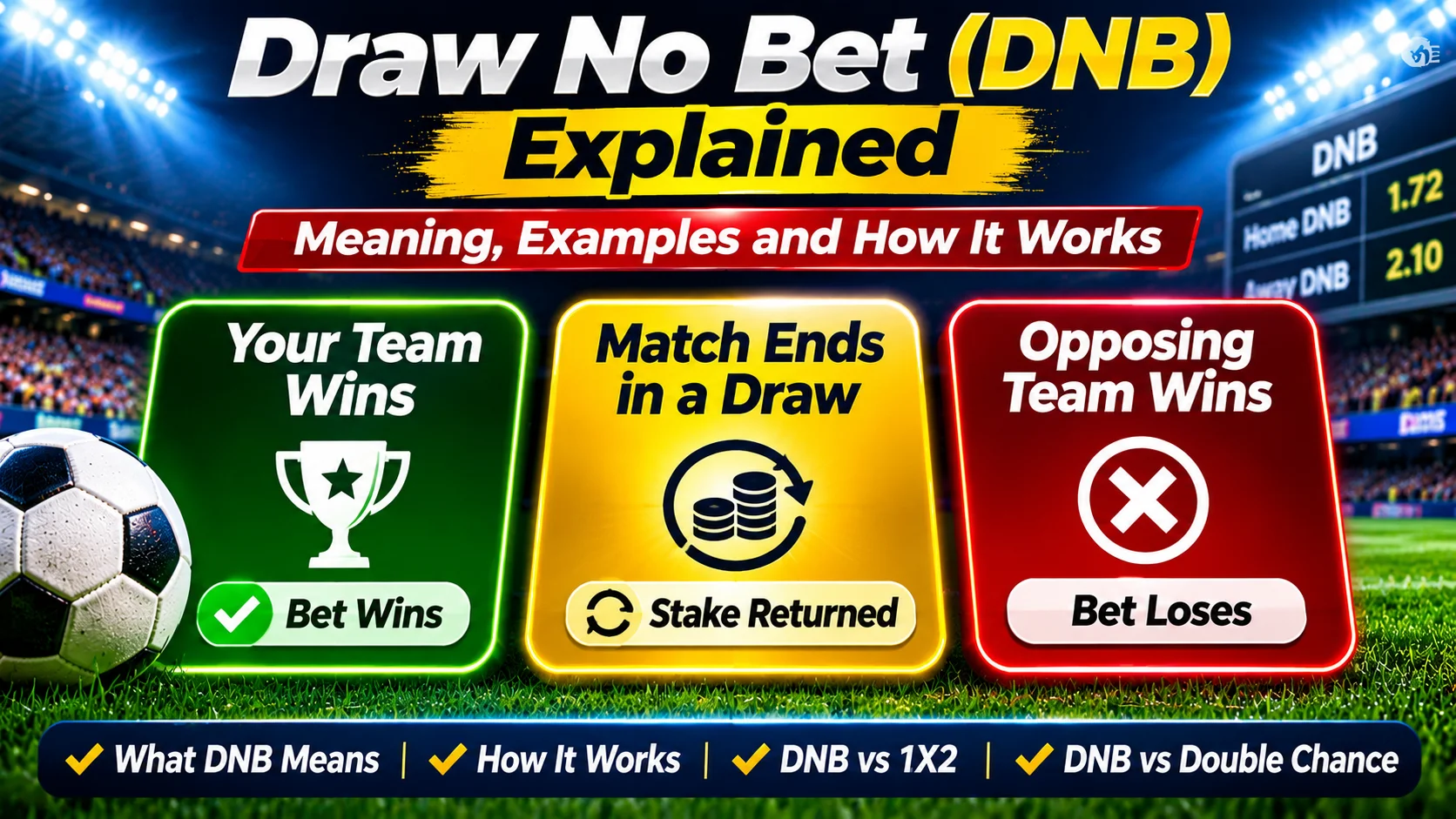
Draw No Bet is a football betting market in which you select one team to win a match. If that team wins, your bet is successful. If the match ends in a draw, your original stake is normally returned. If the opposing team wins, your selection loses.
The abbreviation commonly used for Draw No Bet is DNB.
Unlike a standard 1X2 selection, you do not need to predict the draw as a separate outcome. Instead, the draw results in a refund under the market’s usual settlement rules.
For example, imagine Arsenal are playing Chelsea.
You select Arsenal Draw No Bet.
There are three possible outcomes:
- If Arsenal win, your selection wins.
- If the match ends in a draw, your stake is returned.
- If Chelsea win, your selection loses.
This is the basic principle behind the Draw No Bet market.
How Does Draw No Bet Betting Work?
Draw No Bet is straightforward once you understand the three possible match results.
You select one team, either the home side or the away side, to win.
The bookmaker then settles your selection according to the final result and the specific market rules.
Example: Home Team Draw No Bet
Suppose Manchester City are playing Tottenham at home.
You select Manchester City Draw No Bet with a stake of ₦5,000.
| Final score | DNB outcome | Settlement |
|---|---|---|
| Manchester City 2–0 Tottenham | Home win | Bet wins |
| Manchester City 1–1 Tottenham | Draw | Stake returned |
| Manchester City 0–1 Tottenham | Away win | Bet loses |
The important detail is that a draw does not count as a winning result, but it normally does not cause you to lose your stake either.
Instead, the selection is settled as void and the original stake is returned.
Example: Away Team Draw No Bet
Now imagine Liverpool are playing Newcastle United away from home.
You select Liverpool Draw No Bet.
| Final score | DNB outcome | Settlement |
|---|---|---|
| Newcastle 0–2 Liverpool | Away win | Bet wins |
| Newcastle 1–1 Liverpool | Draw | Stake returned |
| Newcastle 2–1 Liverpool | Home win | Bet loses |
The same settlement principle applies whether you select the home team or the away team.
What Happens When a Draw Occurs in Draw No Bet?
When a match ends in a draw, a standard Draw No Bet selection is normally settled as void.
This means the bookmaker returns the original stake rather than paying out winnings or keeping the stake.
For example:
- Your selection: Home team Draw No Bet
- Stake: ₦10,000
- Match result: 2–2
- Settlement: Stake returned
- Total amount returned: ₦10,000
You do not make a profit, but you also do not lose your original stake.
This is one of the main differences between Draw No Bet and a regular 1X2 home-win selection.
Always check the bookmaker’s market rules because settlement conditions, especially for accumulators and special markets, can vary.
How to Calculate Draw No Bet Returns
Draw No Bet uses the standard decimal odds calculation when your selected team wins.
The formula is:
Potential total return = Stake × Decimal odds
Potential profit = Total return − Stake
Let’s use a practical example.
Suppose you select a team at decimal odds of 1.80 and stake ₦5,000.
| Detail | Amount |
|---|---|
| Stake | ₦5,000 |
| Decimal odds | 1.80 |
| Potential total return | ₦9,000 |
| Potential profit | ₦4,000 |
There are three possible settlements:
If your selected team wins: You receive a total of ₦9,000, including your original stake, assuming the selection is settled normally.
If the match ends in a draw: Your ₦5,000 stake is returned.
If the opposing team wins: You lose your ₦5,000 stake.
Remember that a returned stake is not the same as a winning bet. A draw produces no profit under the standard DNB rules.
If you need a refresher on decimal prices and potential returns, read our guide to how football betting odds work.
Draw No Bet vs 1X2 Betting
Draw No Bet and 1X2 betting are related markets, but they have different settlement rules.
In a standard 1X2 market, you choose one of three outcomes:
- 1: Home win.
- X: Draw.
- 2: Away win.
If you select a home win in the 1X2 market, the home team must win for your bet to succeed. A draw causes the selection to lose.
With Home Draw No Bet, a draw normally results in your stake being returned.
Consider this comparison:
| Match result | Home win (1X2) | Home Draw No Bet |
|---|---|---|
| Home team wins | Wins | Wins |
| Match ends in a draw | Loses | Stake returned |
| Away team wins | Loses | Loses |
The major difference is how the two markets treat a draw.
For a complete explanation of the three standard match outcomes, read our 1X2 betting explained guide.
Draw No Bet vs Double Chance: What Is the Difference?
Draw No Bet and Double Chance are sometimes confused because both markets provide an alternative to selecting one outright result in a standard 1X2 market.
However, their settlement rules are different.
With Draw No Bet, you select one team to win. A draw normally results in a stake refund.
With Double Chance, you select two possible outcomes. Depending on your selection, a draw can count as a winning result.
For example, compare Home Draw No Bet with 1X Double Chance.
| Match result | Home Draw No Bet | 1X Double Chance |
|---|---|---|
| Home team wins | Wins | Wins |
| Match ends in a draw | Stake returned | Wins |
| Away team wins | Loses | Loses |
The distinction is important.
A 1X selection wins when the home team wins or the match ends in a draw. A Home Draw No Bet selection only produces a profit when the home team wins.
If the match ends in a draw, DNB normally returns the stake, while 1X is settled as a winning selection.
For a fuller explanation, see our Double Chance Betting Explained guide.
Is Draw No Bet Safer Than a Regular Home or Away Win?
Draw No Bet covers a different settlement scenario from a standard outright team-win selection because a draw normally results in a refund.
However, that does not make every DNB selection a good bet or guarantee a positive return.
The opposing team can still win, and you can still lose your entire stake.
Before considering a DNB selection, useful factors to examine include:
- Recent performances of both teams.
- Home and away form.
- Injuries and suspensions.
- Team news and expected line-ups.
- Head-to-head results, considered in context.
- The available odds and whether they reflect the match conditions.
The purpose of examining these factors is to understand the match more carefully, not to assume that any betting market removes uncertainty.
When Might Someone Consider Draw No Bet?
Someone might consider Draw No Bet when they expect one team to have an advantage but recognise that the match could finish level.
For example, a team may have performed consistently well at home, while its opponent has shown mixed away form. A bettor might consider the home team in the DNB market rather than selecting a straightforward home win.
However, the odds must also be considered.
Because a draw normally results in a refund, DNB odds may differ from the corresponding 1X2 price. The offered odds depend on the bookmaker’s assessment and market conditions.
A lower-risk-looking settlement rule should not be mistaken for a guarantee of value or success.
What Happens to Draw No Bet in an Accumulator?
Draw No Bet selections can generally be included in accumulators where the bookmaker offers the market.
If a DNB selection wins, its odds contribute to the accumulator.
If the selection is settled as void because the match ends in a draw, bookmakers commonly apply odds of 1.00 to that selection. The accumulator then continues using the remaining valid selections, subject to the bookmaker’s rules.
For example, imagine an accumulator contains three selections:
- Team A Draw No Bet at 1.70.
- Team B to win at 1.80.
- Team C to win at 2.00.
If Team A’s match ends in a draw and its DNB selection is void, that selection normally contributes odds of 1.00 rather than being treated as a losing result.
The other selections must still satisfy their conditions for the accumulator to win.
Always check the bookmaker’s accumulator settlement rules before placing a multiple bet.
Common Draw No Bet Betting Mistakes
Understanding the market is important, but beginners can still make mistakes when interpreting DNB selections.
Thinking a Draw Is a Winning Result
A draw is normally a void result in DNB, not a winning result. Your stake is returned, but you do not receive the potential profit.
Confusing DNB with Double Chance
Home Draw No Bet and 1X Double Chance are not the same. Both cover a home win, but they settle a draw differently.
Ignoring the Opponent
Selecting DNB does not mean the chosen team cannot lose. The opposing team can still win, resulting in a losing selection.
Looking Only at the Odds
Higher odds do not automatically mean better value. Consider the teams’ performances, match conditions and the probability of the different outcomes.
Forgetting to Check Market Rules
Some betting markets have special settlement conditions. Confirm whether the selection applies to full-time results, extra time or another specified period.
Frequently Asked Questions About Draw No Bet
What does DNB mean in football betting?
DNB stands for Draw No Bet. It is a market where you select one team to win. If the match ends in a draw, your stake is normally returned.
What happens if a Draw No Bet match ends in a draw?
A standard DNB selection is normally settled as void, and the original stake is returned. There is no profit from the selection.
Do you lose money if your Draw No Bet team loses?
Yes. If the opposing team wins, your selected team has failed to win and the DNB selection normally loses.
Is Draw No Bet the same as Double Chance?
No. Double Chance covers two possible match outcomes, while Draw No Bet selects one team to win and refunds the stake if the match ends in a draw.
Is Draw No Bet the same as 1X2?
No. Standard 1X2 betting requires one specific outcome: home win, draw or away win. Draw No Bet selects one team to win, with a draw normally resulting in a refund.
Can Draw No Bet be used in accumulators?
Yes, where the bookmaker offers the market. If a selection is settled as void following a draw, its odds commonly become 1.00 in the accumulator, subject to the bookmaker’s rules.
Does Draw No Bet include extra time?
Standard full-time Draw No Bet markets normally settle using the result after regulation time, including stoppage time, and exclude extra time and penalty shootouts unless the market rules state otherwise.
Final Thoughts on Draw No Bet Betting
Draw No Bet is a football betting market that allows you to select one team to win while treating a draw as a stake-refund outcome under standard settlement rules.
The important points to remember are:
- A win by your selected team means your bet wins.
- A draw normally means your stake is returned.
- A win by the opposing team means your bet loses.
Understanding how DNB works makes it easier to compare the market with standard 1X2 and Double Chance betting.
Before choosing any selection, take time to understand the odds, match conditions and settlement rules.
Bet responsibly. Football results are uncertain, and no betting market guarantees a return. Only participate where legally permitted and never stake money you cannot afford to lose.